2009 Schleeping Pad Smack-Off

I know that my hiking “partners” Frank and McL are looking for less spartan sleeping solutions in 2009. By spartan, I’m referring to the closed-cell foam pads that we’ve carried in years past. There are some benefits to a closed-cell foam pad: apart from being very light, they make for a good base insulation in wintery conditions, they provide for structure in a frameless pack, they are extremely durable, and they make a makeshift cozy for freezerbag cooking. One thing that they are not is comfy! In order to help a brotha out, I’m providing some details on the state of the sleeping pad market for 2009.

For the smack-off, I’m not including any super-heavy self-inflating pads. These are too heavy to be considered for lightweight backpacking. All but one of these options have been around for some time; there’s one new entry for April 2009! Note that I’m not in the running this round: I have too many pads already and will be rocking a 2/3 length Ether Thermo 6 for the 2009 hiking season!

Sleeping Pad Option Weight Size (in.) R Val Cost Notes
Balloonbed Inflatable 3.5 oz 17x47x1.7 ~1.0? ~$30 Hella light, hell to inflate, balloon animals!
Thermarest RidgeRest (short) 9 oz 20x47x.67 2.6 $19.95 The most comfy of the spartan!
Big Agnes Clearview (petite) 11 oz 20x60x2.5 1.0 $47.95 Comfy & long, but no insulation value
POE Ether Thermo 6 (2/3) 15-16 oz 20x48x2.5 6.8 $65 Good mix of comfort and R value
Thermarest NeoAir (small) 9 oz 20x47x2.5 2.5 $119.95 Lightest ultra-comfy pad; horizontal tubes

Where cost is no consideration, the NeoAir is the winning option for this smack-off! To save weight, it uses a reflective barrier instead of insulation to reflect the warmth back to one’s body. Even the regular size @ 72 inches long weighs a paltry 14 oz, but costs a staggering $149.95! Something that I’m particularly interested in is the horizontal tubes which make for a flatter sleeping surface.

NeoAir

So you be the judge . . .. What is your pad of choice for a comfortable 2009?
Posted in Gear Reviews | 1 Comment

GSI Hae Tea Kettle Review

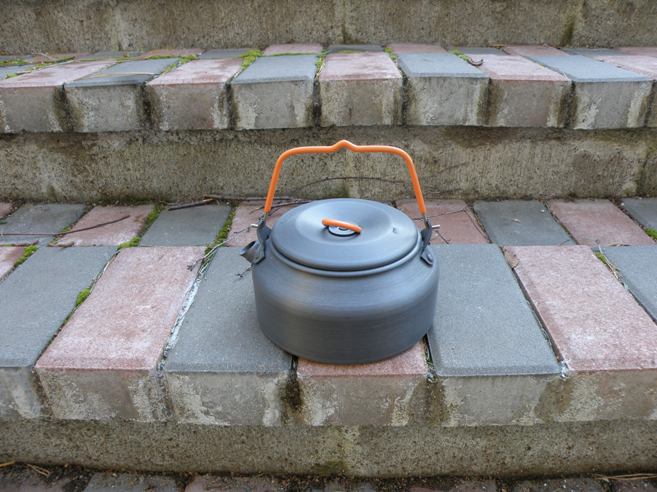
Another piece of gear, another gear test . . .. I received my GSI Kettle this week from REI. Made of hard-anodized aluminum, it’s heavier than a piece of titanium gear weighing in at 5.5 oz. The aluminum is extremely durable, however, and is a flatter shape than a typical cookpot. It measures in at 6.13 inch width and a 3.5 inch height, making it ideal for White Box Stove usage.

Testing a cookpot requires the most authentic test/trail conditions

It’s very roomy and provides a handle for the kettle and lid. This is obviously ripe for home-modification, but is somewhat pointless due to the fact that it will only save some grams and require a glove to handle it upon boiling.

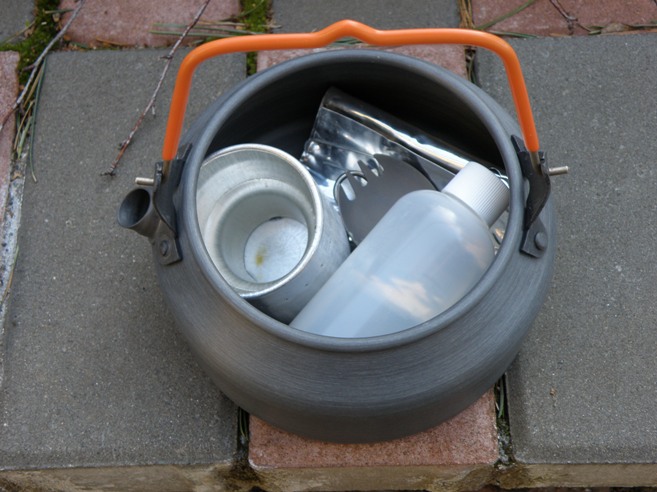
It's suitable to carry a white box stove, wind screen and primer pad, as well as a 4 oz fuel bottle and a titanium spork.

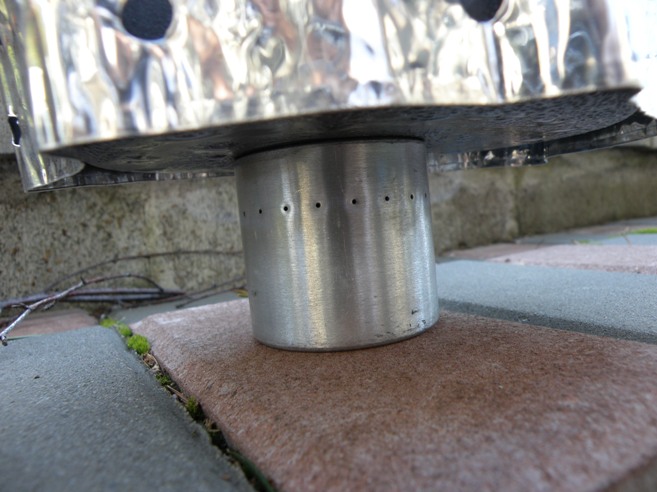
One of the reasons that I procured this item is due to it’s width and ability to contain the blossom on the White Box Stove. My other cookpot, a Snow Peak Trek 900 is only 5 inches wide, causing the flames to lap up the sides and an inefficient boil time.

Blossom in relation to pot width/diameter

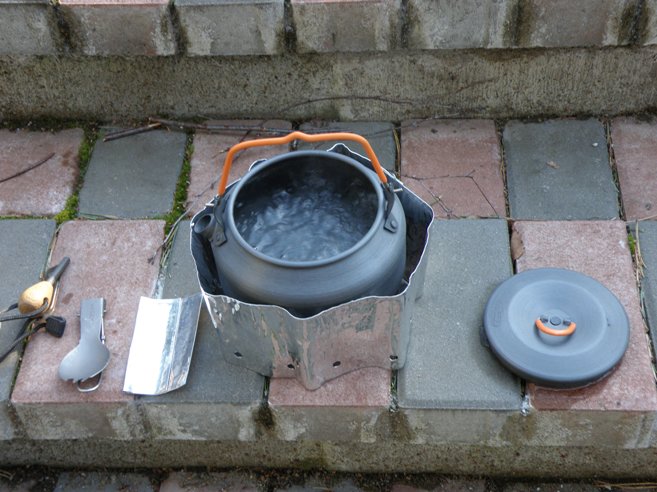
The boil time for the kettle is ~9 minutes for 24 oz of water, which is plenty efficient. I didn’t do a boil-off for this test, but I was comfortable with the time required to boil water for three hungry hikers averaging 8 oz of water apiece for dinner. It’s definitely easier to pour, although there’s no accurate way, unless I Dremel the interior to measure the water poured for each freezerbag. I’ll think about this, but believe the eye-method should work enough.

Rollin, rollin, rollin . . .

Conclusion:

+:

  • Efficient to boil
  • Extremely durable, especially for using a Bushbuddy Ultra or open-fire cooking
  • Very roomy
  • Wide design

-:

  • Heavier than other options; would be extremely light in Titanium
Posted in Gear Reviews | 1 Comment

Glacier Peak Loop

A Little Something For the Effort

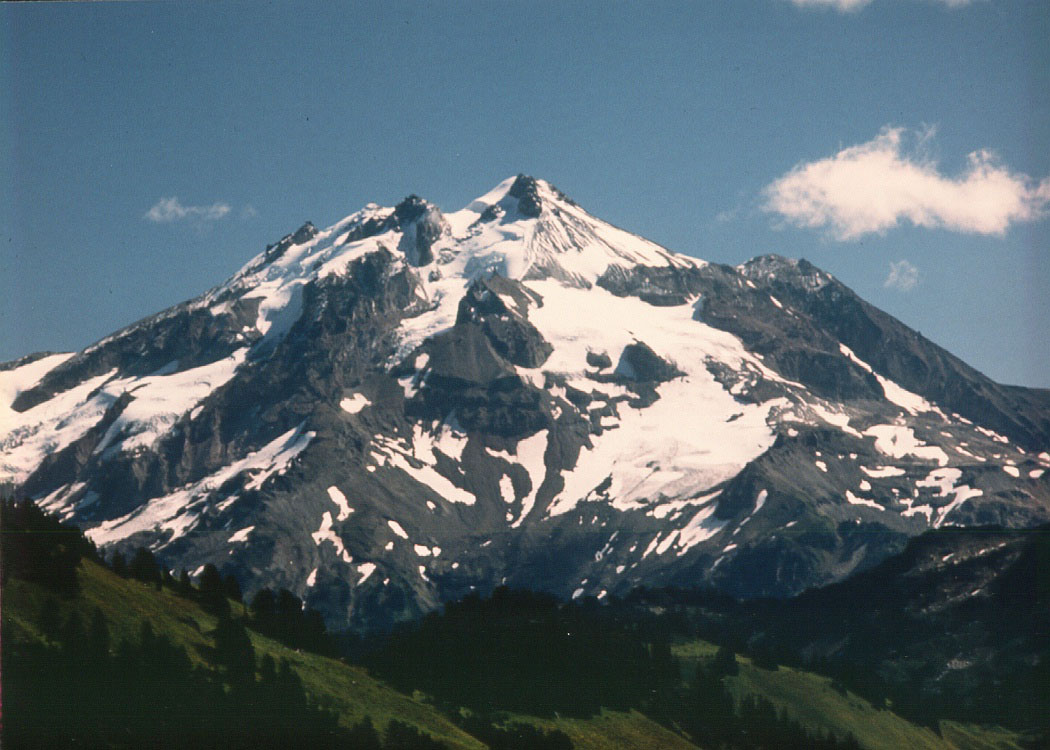
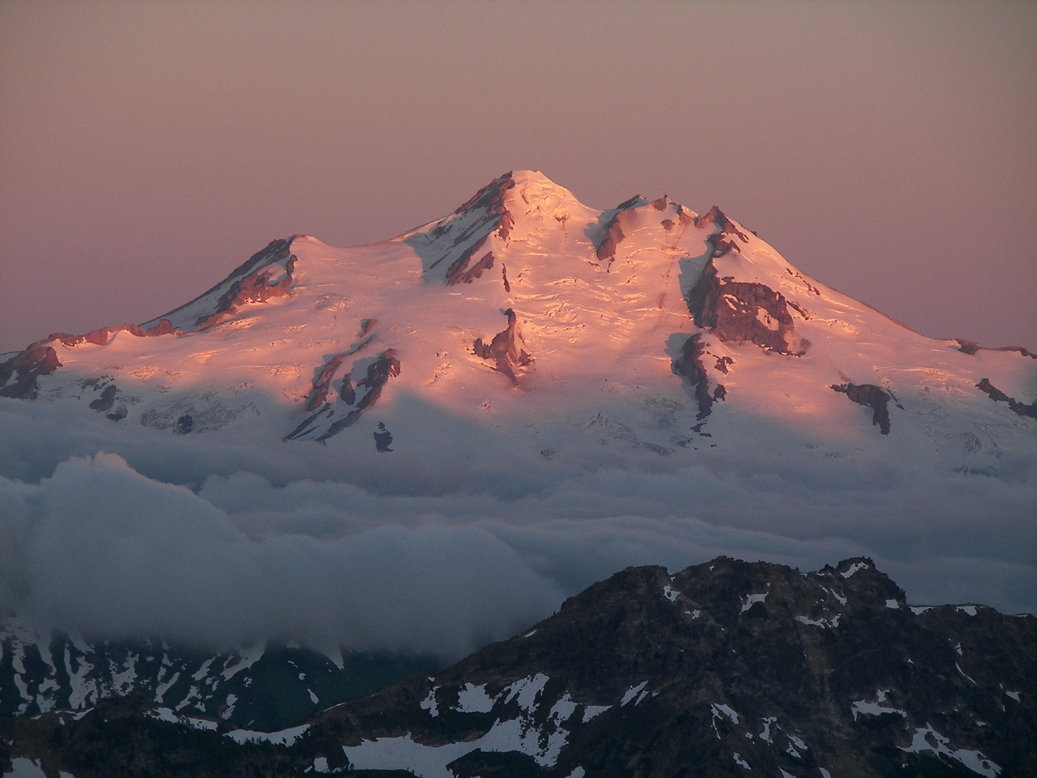
The sp*mming continues! Seeing as Ploss is still jonesing for a truly bone crushing death march, I offer the following Olympic alternative: the Glacier Peak Loop.

This 98-mile odyssey through Washington’s North Cascades Glacier Peak Wilderness not only runs a good stretch of the PCT, there’s apparently a nice chunk of it missing. That’s right, our old friend Douglas Lorain reports in Backpacking Washington that:

A short but important section of trail connecting the Napeequa River with Little Giant Pass has been abandoned. The tread still exists, sort of, but its is steep, difficult to locate, and dangerous to hike. Even if you manage this section you still must negotiate potentially difficult crossings of the Napeequa and Chiwawa rivers.”

Yeah! The news for Ploss gets better courtesy of GORP:

Rangers sometimes sound frankly gleeful on the subject of things like bridges taken out by avalanches, campsites under snow in the middle of August, and man-eating mosquitoes. These are remote, high mountains in a northcountry wilderness, so take their warnings seriously.

[snip]

To avoid avalanche chutes, glaciers, and permanent snowfields, the trail descends into valleys and climbs back up to passes, so expect a lot of ups and downs.

[snip]

Weather: Snow usually clogs the mountains well into July, and winter storms start sometime in September or October, leaving August as the best month for this traverse. The high peaks are weather-makers, so expect weather to be made. It can snow any month of the year.”

This would appear to be as close to final frontier available w/in 8 hours of Smackland, and for obvious reasons is penciled out as a 9-12 day excursion to complete the entire 98 mile circuit. Total elevation TBA. While shorter variations and section hikes of the area exist, only a real wuss would settle for anything less than the full meal deal.

Suffice to say there is a wealth of information to further sort through before clearing out a few weeks on the calendar, but the place to start is with the map. Considering the mountaineering aspects of this expedition, this could either supplant the Olympic/Adams events planned for 2009, or could be the mother of all trips to plan for in 2010.

Posted in Backpacking, Mountaineering | 1 Comment

Elwha – Quinault Cross-Olympics Traverse/North Quinault – Skyline Trail Loop combo

He’s Going The Distance.

Wikipedia defines Self-injury (SI), self-harm (SH) or deliberate self-harm (DSH) as “deliberate infliction of tissue damage or alteration to oneself without suicidal intent.” For Ploss, it means that a 55 mile, 14K foot hike doesn’t cut the mustard. I therefore offer Backpacking Olympics addendum 1: the McLovin-cobbled +/- 87 mile Elwha – Quinault Cross-Olympics Traverse/North Quinault – Skyline Trail Loop combo.

Figa’ing this one out will require 3 map purchases, but as the 2 intersect, as far as I know, the North Quinalt River trailhead there is at least a possibility of rocking some portion of the Elwha-Quinault Cross-Olympics Traverse as an up-and-back, followed by the full circuit of the North Quinalt-Skyline Trail Loop.

Using the North Quinault Trailhead as the axis of our journey, we could head north towards the Elwha River near Port Angeles – 45 miles distant. This in and of itself could be a 90 mile there-and-back hike, but I’m thinking (maplessly) that we could head to Martins Park in the Low Divide and back for a roughly 45 mile trip. Or, it could be 60 miles ?!? – to be determined. Upon returning to Franken’s sled/cache we can restock for part 2, the 42 mile North Quinault – Skyline Trail Loop. This feel is apparently the road not travelled – bear are plentiful and BPW states that:

…much of the route [snip] is so faint and rugged that it reuqires an extraordinary amount of both physical and mental energy to follow. Although the author enjoyed this trip, he can recommend it only to very fit backpackers who are experienced at route finding. Anyone else would probably find this hike to be too difficult to enjoy”

See: Wikipedia definition of SI, SH and DSH. I’ve found several conflicting trip reports on the interwebs about the starting points, distances, elevation and waypoints of both hikes, so it would seem that the actual maps and some better recon would be in order before researching this one further, but I’m intrigued. There are few other Olympic hikes one can cobble together in any semblance of a loop, and these two are in fact only mentioned briefly in the BPW “Other Backpacking Options” appendix. Regardless, an out-and-back north/south towards Elwha on the traverse from North Quinault followed by the Skyline Trail Loop would require at most a short drive mid-week from where hike one ends to wherever in the F hike two begins…and could be quite money. Or deliberately self-harming. McLovin reports: you decide, and I’ll have a follow-up recon report if this has universal appeal.

Posted in Olympic NP | Leave a comment

Backpacking Olympics

I’d rhetorically ask you to explain to me why backpacking isn’t an Olympic sport – it certainly wouldn’t be any more boring to watch than “sports” like the biathlon, swimming, soccer – but I’m obviously preaching to the choir. Backpacking on TV is awesome, right? Well, maybe only when some euro is teaching you how to survive in the wild, because watching some American kid perish in an old van was, sorry, not awesome. Maybe it’s me. Well until backpacking takes its rightful place as a world class sporting event, may I suggest our own off-year Olypmic event: the Northeastern Olympic Loop.

Traversing Cameron Creek below Mt. Cameron (7192')

I’m throwing this one out as a first suggestion for our 2009 event as it meets a number of group requests/requirements:

  • It’s relatively close (Ploss, Franken, McLovin) – Google Maps calls it 4 hrs. 19 minutes from Chez McLovin
  • The daily average distances are down from the WLT (Franken)
  • It provides plenty of grim (14,000′) vertical (Ploss)
  • It’s apparently quite a scenic old growth forest/mountainous region (Ploss, Franken, McLovin)
  • It’s in the Olympics (McLovin, having McLovined himself out of the 2007 Olympics)
  • It’s a loop (Ploss, Franken, McLovin)
  • Potential for stealth camping, as well as optional campsite reservations available in Grand Valley

The area also tends to be drier than the western Olympic peaks, providing potentially for a better chance of killer weather, especially if we go in August which is also my suggestion. A few cons:

  • As detailed in Backpacking Washington it’s a relatively short 55 miles with side trips
  • Bear country: hard canisters “recommended” where bear poles are unavailable
  • Few glaciers (navis rainforests) but…
  • Some “dangerous” snowfields through late summer that make wayfinding difficult, especially if you’ve been McLeft behind

The facts: BPW scales this as a 4-7 day trip over 55 miles with 14,000 feet on elevation gain, which would figure to be likely about 9.2 miles and 2,333 feet per day over 6 days, say Sunday to Friday. That’s pretty pounding. On the 1-10 scale BPW rates this hike with a 9 for scenery, 5 for solitude, 7 for difficulty – pretty solid ratings. My man Douglas Lorain suggests we rock it in 5 days:

Day Camp Miles Elevation Gain
1 Falls Shelter 10.4 1800′
2 Dose Meadows (via Cedar Lake) 13.2 3800′
3 Dose Meadows (day hike to Hayden
Pass and Thousand Acre Meadow)
8.2 1600′
4 Grand Valley 10.7 4300′
5 Out (via Obstruction Peak) 12.2 2500′

Your thoughts, please: I think this hike fits the collective bill, and obviously should Ploss and Franken express an interest in further details, further details will follow. By several accounts this is a beautiful, difficult hike (Ploss) that we can accomplish inside of a full week (Franken) providing for bringing less food (P.F,McL) and more down time to enjoy Olympic splendor on the left hand side.

Posted in Olympic NP | Leave a comment

MYOG

The next great frontier in gear . . .. Is it gear that sheds precious ounces of weight? Is it the latest materials (e.g. eVent, possumdown, titanium, etc.)? Is it gear purchased exclusively from cottage manufacturers? No. It’s gear that you’ve made your own-freaking-self. We’ve already started making our own boil-in-bag cuisine, so why not explore more challenging pursuits.

Franken is already experienced at fashioning items using mylar, empty soda cans, hollow aluminum, and lightweight rope. This includes an ultralight tarp, stakes, stoves, and a bear bag. These may seem easy compared to the next echelon of homemade equipment: sleeping bags, packs, and bivy sacks.

There are many useful sites on the interwebz that specialize in making your own gear (MYOG). As examples, Thru-Hiker provides kits, fabrics, and materials for making your own shite and Backpacking dot net provides a plan database for gear construction.

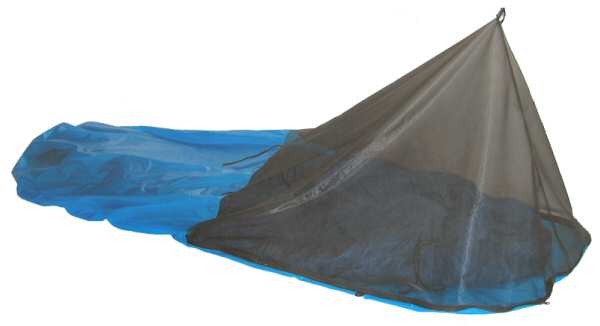
One particularly interesting design, in light of many recent posts on bivy sacks, is the meteor bivy provided by Six Moon Designs.

A very roomy option for tarp camping. The plans provide a weight of ~10 oz, which could likely be modded signficantly.

At any rate, this is just a taste. All of this is food for thought if that “perfect” piece of gear that you require is not yet available in the marketplace . . ..

Posted in Gear Reviews | Leave a comment