What’s more imporant about celebrating a new year than the ability that one has to share their perspective on the gear triumphs from the previous year! Given that Frank only provides climbing-related posts now, I’ve taken the liberty to reflect on Franken’s gear additions in 2008 and have made my best attempt at summarizing the top five! Top ten lists are too cliche to be used here . . . in this case, only five will do.
Item #5:
Ladies cotton underwear (available where granny panties are usually sold): Why wear boxer briefs into the woods when cotton panties will do? They are extremely light and while not skid-proof, they are disposable! Say “nah” to modern fabrics with odor-defying properties and heavier solutions . . .. Ladies panties are the best solution for any self-respecting male backpacker! Goes great with an ultralight scarf!
Item #4:
REI OXT Tech Tee (in white): When not used as a thong, cotton kills! This solution wicks moisture and handles abrasion extremely well! It’s also suitable for wearing into town. In a white color, this tee is sure to attract any dirt, food spills, and tobacco residue that a week on the trail can provide. Guaranteed to make other hikers stay out of your comfort-radius and establish that hobo presence that anyone would want in the woods!
Item #3:
Drum Rolling Tobacco: When one travels ultralight, they would generally segregate their needs and wants for the trail. The critical wants are often categorized as “luxury” items and indicated as such to avoid gear list heckling! One precious luxury item for Frank from 2008 is roll-your-own tobacco. When hankering for the taste of the trailer while in the woods, only one solution will do, Drum tobacco. If only it came with ultra-light moonshine. Remember: leave your health at home when you travel in the woods . . . tobacco actually enhances one’s performance at altitude!
Item #2:
Homemade hollow aluminum stakes: Do stakes really need to withstand the blow of a misplaced foot? Do they? Fashioned out of hollow aluminum. 6 weigh less than .5 oz. Just be very careful as they are highly susceptible to breakage from a gentle breeze, a landing mosquito or any precipitation, much less a drunk Franken!
Item #1:
Homemade space blanket tarp: Why be stealthy when camping in the woods? Throw out the cone of silence and use Franken’s homemade space blanket tarp. While extremely light, this item is certain to keep everyone awake within a 200 yd radius due to it’s very loud mylar material. Just remember to bring a buddy with more dependable gear for use in windy or damp conditions and/or a roll of duct tape in case you need to complete a field repair! In 2009, perhaps he’ll consider “moving-up” to Tyvek!
I received some fresh, piping-hot gear this week. Most important of my new arrivals was a new Gatewood Cape. Could this be the finest cape/tarp in the freaking world? Stay tuned to see my evaluation!
First things first, the Gatewood Cape weighs in @ approximately 11 5/8 oz when seam-sealed and including the harness, main guyline, and smaller, 16-inch guylines for the perimeter. While not as light as other poncho/tarp combinations, it provides a complete shelter that doesn’t suffer from their limitations (e.g. the hood compeltely seals off and will not create the “bucket effect” commonly seen in poorly setup poncho tarps).
The erected cape!
Setting up the cape is really simple. You simply stake either side of the vestibule and another in the rear loop making a triangle in the cape. Assuming that the harness is already assembled (there’s no need to remove it for wearing in “cape” mode), all that is needed is to insert the hiking pole into the grommet hole in the harness pointed towards the vestibule, attach the main guyline (attached to the harness) to the vestibule with the hook attachment, stake it off, and stake the remaining two guylines. It only takes about five minutes to setup.
Here’s an overview of the unique features of the shelter:
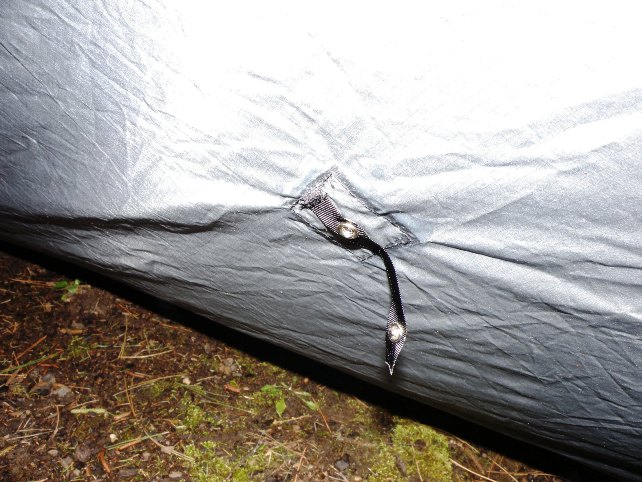
Vestibule Door Toggle-Loop:
There's a toggle-loop combo for pulling back the door.
Hood Harness:
The hood harness is color-coded, making it virtually jackass proof. The grommet hole prevents the tip from impaling the silnylon.
Main guyline hook:
A sliding hook is attached to the main guy-line allowing it to be easily attached to the vestibule
Hoodie:
The hood seals off completely with the attached cordlock
Bivy hood connectors:
There are attachments on either side for elevating the hood of a bivy sack (eliminating the need for a separate wire) and shortens the cape sides
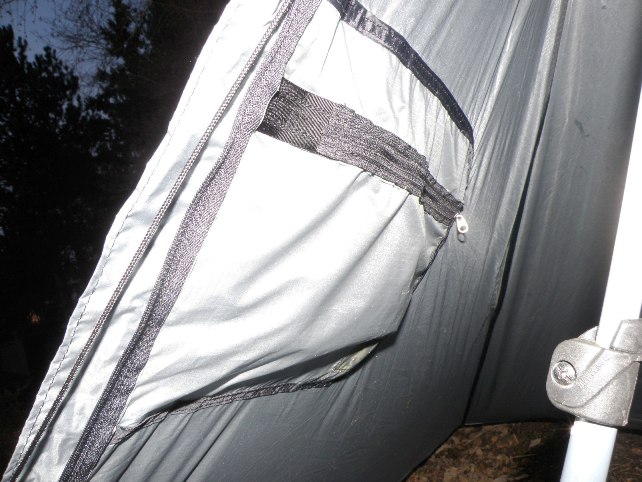
Interior Pocket:
The interior pocket acts as a stuff sack, cape and shelter pocket. Very useful for keeping crushable items out of harms way.
As noted by Mclovin in his top ten gear items post, the cape is perfect and works well both as a cape and shelter. As noted above, it provides a lot more options than a typical poncho. There’s a two-way zipper that creates ventilation options when either worn or as a shelter. It requires only six stakes in total vs. eight-ten for a typical poncho/tarp.
It provides a great many ventilation options with zipper and pole length options
Multi-use: operates as both a cape and shelter
Easily provides room for a single person, backpack and anything else that needs to stay dry
What’s not so great:
The normal drawbacks of any tarp (no netting to keep insects away, no floor, etc.)
It’s heavier than other options that exist (although much more functional)
This item will be part of my 3-season kit moving-forward. It is extremely innovative! Ron Moak has done an excellent job of thinking this completely through!
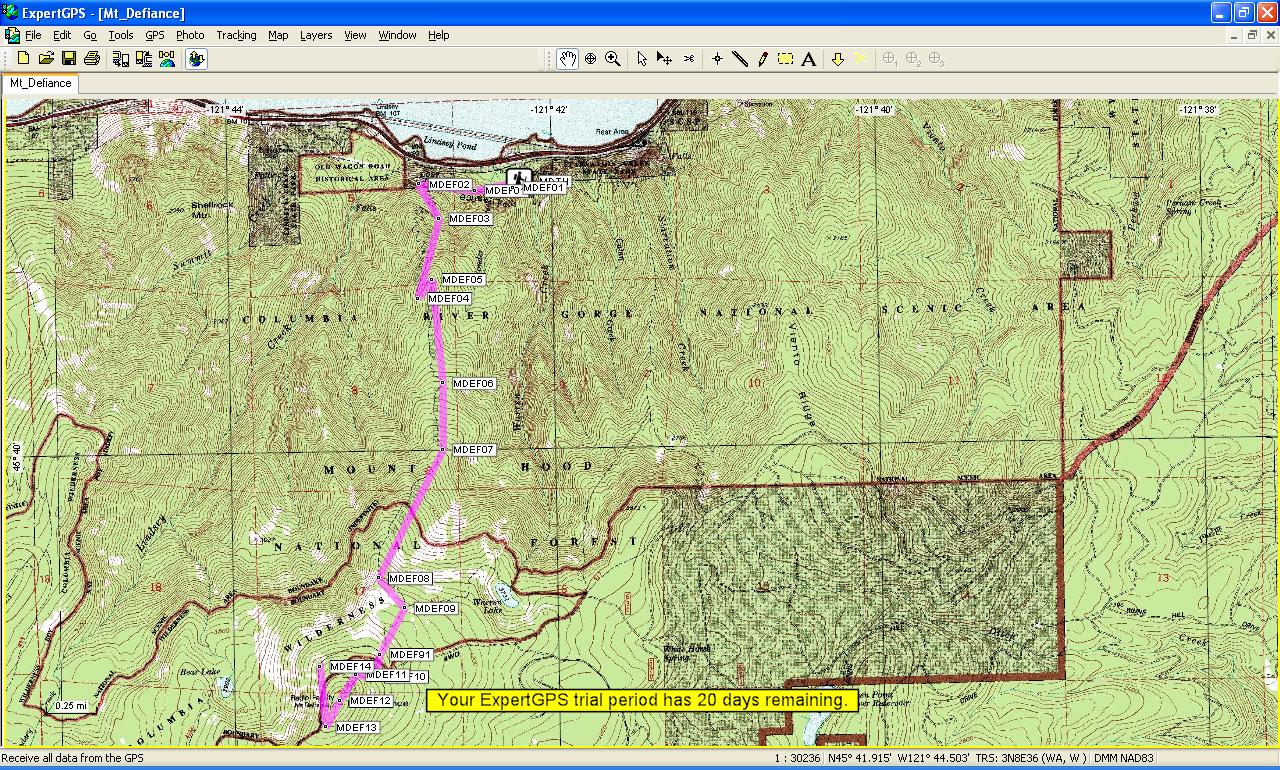
You thought Ruckle was tough? Mt. Defiance is the uber of the gorge hikes. 4800 ft in 6 miles. We need to do this in the spring and be in good shape to do so
To Reach (From Portland):
Take I-84 eastbound approximately 50 miles, ten miles past Cascade Locks. Take the Starvation Creek exit near milepost 54. (From Hood River take Wyeth exit #51 turn around and head back east). The “closed” sign is only for the restrooms, not the trail or parking area.
The Trail:
This trek to the highest summit in the Columbia River Gorge gains nearly 5000 feet in less than six miles, giving even the most well-conditioned hiker a real workout. Mountain climbers use this trail as preparation for climbing mountains (or as we’ve heard, they climb mountains to prepare for this trail!). There are easy trails that you can take in the area, such as the 2.5 mile option to Hole-In-The-Wall Falls, but most people take a deep breath and go for it.
Once at the trailhead, follow the path along the shoulder of the freeway to the west , until it veers into the woods. You’ll pass Cabin Creek Falls, and after 0.8 miles, cross a footbridge below 100-foot Hole-In-The-Wall Falls (so named because it comes out of a tunnel in the mountain). In another 0.1 mile, you’ll come to the Starvation Ridge Trail. Continue straight past the Starvation Ridge Trail junction for another 0.2 miles to 20-foot Lancaster Falls. At this point, you’re thinking “this isn’t so bad!”. That’s where the fun begins…
After another 0.5 miles or so, the trail launches upward. You’ll follow switchback after switchback through the woods for three miles or so before coming to Mitchell Point Trail. Continue uphill to the right for 0.2 miles, until you come to an unmarked trail to the right. Take this unmarked trail and clamber across the rocks, taking in great views along the way. Curve to the left up to the microwave towers at the summit.
To return, walk past the fenced microwave building to an old wooden trail sign. Take the road downhill, past two dirt road crossings. When you hit the Mitchell Point trail, turn right. You’ll drop down to Warren Lake, where you can take a swim on a hot day. After the lake, continue for another half mile where you’ll take a left on the Starvation Ridge Trail. Continue downhill, wincing at the pain in your knees, until turning right on the Starvation Cutoff Trail at the bottom to return to the car.
Before I go all hey my gear sucks I need all new gear on myself (and y’all) here’s my* list of my* favorite shite. The 2009 list will undoubtedly include shiny new gear (sorry old gear).
1. Six Moon Design Gatewood Cape: order it now. No, seriously why are you still here. Ultimate UL multipurpose item available.
2. GoLite Jam2 Pack: it’s a 22 ounce backpack in a comfortable, simple design. Perfect for even a whole week on the trail if you’re not bringing the kitchen sink.
3. Tech4o TraiLeader 2: kick ass watch/altimeter/accelerometer/compass/thermometer/pimpy hiking gadget. Next best thing to a GPS, a topomap, an actual compass, or a sense of direction.
4. White Box Stove: as the proud owner of 4 alcohol stoves (and 1 lunar lander) this one is the best, hands down. This light ass item eliminates the need for a pot stand with a superior design that permits direct pot contact, thus maximizing surface contact with jets, and minimizing the demand for a wind screen (included). Only stove you’ll need (unless you like collecting them, like me).
5, Petzl e+LITE Headlamp: this has quickly become the favorite of the…5 light sources I currently own, owing to a best combination of weight (.9 oz), versalitiy (white + red LEDs), small/efficient headband (vs. Photon Microlight clip-ons) and cost ($30)
6. Mont Bell Down UL Inner Jacket: 8 ounces of light, warm comfort, feels like a hug from Mommy.
7. FireLite SUL-900 Titanium Pot: Best. Lid. Ever. Weighs less than 3 oz. with more than sufficient capacity (34.2 oz.) to cook 3 freezer bag meals (24 oz. H2O) with ~1 oz. denatured alcohol in the aforementioned white box stove with which it works perfectly.
8. SteriPEN Water Purifier: this would have been rated higher if I hadn’t had an issue on-trail that forced me to rock delicious iodine one lonely thirsty afternoon. Mmmm mmm! I can taste the purplish brown now. Advice: keep “unit” dry.
9. Bodyglide: Ohhh yeah. And, it totally rocks for keeping your wheels blister-free
10. Ex-Officio boxers: you can actually rock these comfortably for several 20+ miles days. Wear 1, carry 1, wash 1, repeat. Nuf said.
Earlier, I blogged about my first full day on the WLT as my gimpy ass joined Ploss and Franken for their 5th day circumnavigating Mt. Rainier. My second day was somewhat less grueling, somewhat less scenic, significantly more solo and definitely as rewarding.
Day Two: Nickel Creek to Longmire
Slept like a rock in my bivens under clear skies that night sans tarp/Gatewood cape and we broke camp early again, hitting the trail once again about 7:30. I’m pleased to report that while I may have been the last one out of camp, I was only about 30 seconds behind – in the weeks post-Ruckel I had endeavored to persevere and my daily doubles had paid off. We stopped for 20 and some H2O at Nickel Creek itself, both of which turned out to be serious tighteners as I would rock the rest of this second iPod-less day low on water, w/o a working SteriPEN, shall we say fully conscious and utterly alone.
Section 1: Nickel Creek to Maple Creek
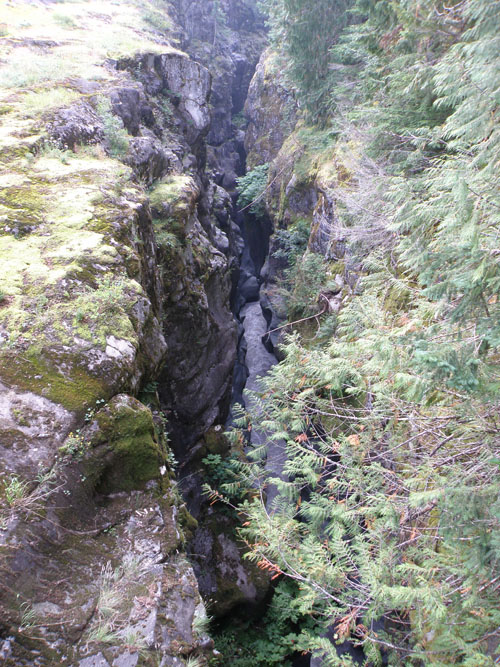
The day started off much like the previous one with a relatively flat jaunt to Maple Creek during which we made excellent time. The trail here (as was the case mostly from White River) is in excellent condition, and is particularly wide and rootless. It is however almost exclusively buried in the forest so the scenery was rather…foresty. The exception was just past the first mile as you descend into Box Canyon which includes road access and a visitor center – and more importantly the amazing Box Canyon itself, carved narrowly and deeply into the rock hundreds of feet below.
Box Canyon was deep! This area is car-accessible and would make an excellent alternate entrance (or emergency exit)
From here the journey to Maple Creek is again generally wooded, generally flat, and generally pleasant. Take 5 (or stop for 20) at Maple Creek and be sure to fill up on water – it’s going to be awhile before you have such an accessible and favorable source again.
Section 2: Maple Creek to Reflection Lakes
Cue the Rocky music: here, yours truly had his second most difficult time on trail, ever, though it wasn’t so much one single thing like the elevation gain or the often challenging terrain or the sometimes thick brush, or lack of dutchy, clean water, something other than delicious iodine with which to make clean water, or the knowledge of exactly where in the F you are relative to the summit. It was all of the above mashed into one 6 mile soul crushing, soul searching assault on self doubt, f’d knees and the Wonderland Trail. And I freaking won. High five, me; hope I didn’t give too much away.
On paper, this section (and the whole day for that matter) looked like a piece of pie. Sweet cherry pie. At first, the trail wanders alongside Stevens Creek for what seems like forever, making a gradual ascent through thick ferns, brambles and other briar patch items in what must be the closest thing to bushwacking on the entire Wonderland Trail, as far as I know. Then, it just starts going straight up without the niceties of a switchback for mile. After mile. After mile.
Nothing to see here. Move along.
Occasionally, you’ll see some are we there yet? sign that says nope, you’re not there yet, cross a road, see a log truck and think, I could probably hitch a ride to Longmire…no! Bad McLovin! You will persevere! Here, let’s stop and fill up with water and use our trusty SteriPEN. SteriPEN? Red light: bad. Mmm, iodine and a 45 minute wait it is. Nevertheless I trodged onward and upward and finally reached beautiful Reflection Lakes.
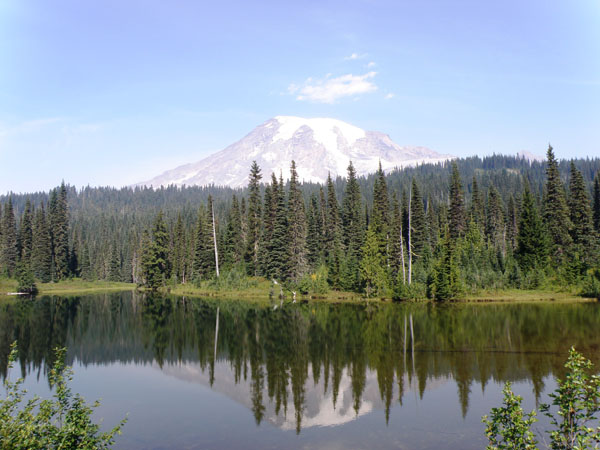
Reflection Lakes lived up to its name...other than I only observed a single lake...
You’re actually hiking on the side of the highway at this vista, and I shared this viewpoint briefly with a group of tourists from a non-english speaking country doing their best impression of every caricature of their populace imaginable, right through the point they got in their car and drove away, mostly within the painted lines on the road. Mostly. I waved goodbye and headed out to Paradise.
Section 3: Reflection Lakes to Paradise River
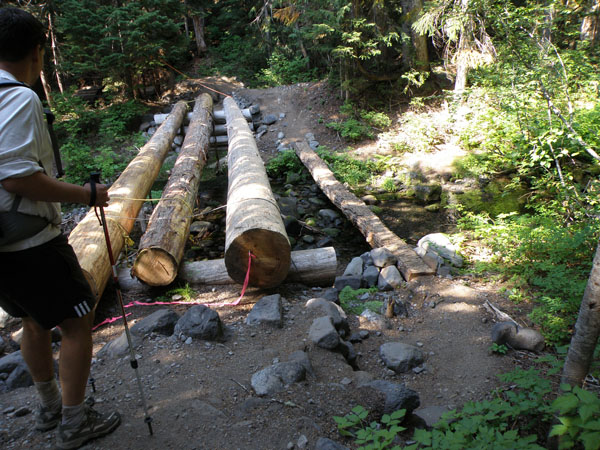
I knew – KNEW – that this section was going to be a breeze and for the most part, it actually was. I was making pretty good time until reaching an area devastated by the storm of 2007 not far short of the spur to Paradise. There’s a short but unwelcome uphill detour where a section of the trail was washed out, which leads to a scenic waterfall area I declined to investigate as I was hoping to reach Longmire reasonably close to the same time as Ploss and Franken who were of course on their seventh full day on the trail. Time to double time it. Within an hour I reached Paradise River where a Forest Service crew was busy cleaning up fallen trees and making trail and bridge improvements, which also gave me an opportunity to fill up on water, one last time.
From Ploss' archive: Franken crosses Paradise River (I was 20-odd minutes behind)
Section 4: Paradise River to Longmire
It’s all downhill from here, and this also marks the last time views of the mountain are available at all – in fact, other than a crossing of the Nisqually River, the trail is confined within the forest for this entire 4+ mile section. I made excellent time. Other than a who? moment of said Nisquallly crossing where you can’t see the confounded bridge as it’s obscured by the world’s biggest car camping slash pile, it was an uneventful speed walk down to Longmire – completing this 14.5 mile section.
I couldn’t have been happier to reach my destination, marking the end of my two days on the Wonderland Trail. Thankfully, I hadn’t kept ironmen Ploss and Franken waiting too long. Props to them for completing the entire trail in 7.5 days! They f’n worked it and, to a much lesser extent, so did I. Two of the best days of my life.
Earlier, I section hiked the Wonderland Trail from White River to Longmire, and was remiss in blogging said experience. I correct that omission presently ’cause it was freaking $.
Day One: White River Campground to Nickel Creek Camp
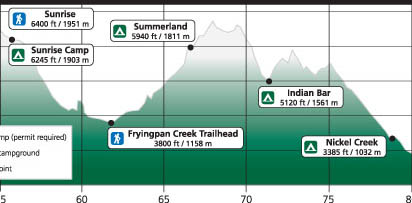
Trail profile: White River to Nickel Creek
I joined Ploss and Franken in progress at precisely the appointed hour of 3pm along the main road that winds through the White River Campground. Several wanderings later, we procured our caches and staked claim to the best that car camping has to offer. That is to say, unless you really like “camping” with lots of other people (though nary an EEE-eye-EEEEE was heard) or you’re meeting some section hiking gimp whose wheels won’t permit circumnavigation of the entire WLT, rack at Sunrise Camp. I did however bring some brews.
Section 1: White River to Fryingpan Creek Trailhead
The next morning we broke camp early about 7:30am, broke my iPod even earlier, and headed out on the first leg of the day: a leisurely stroll down to the Fryingpan Creek trailhead.
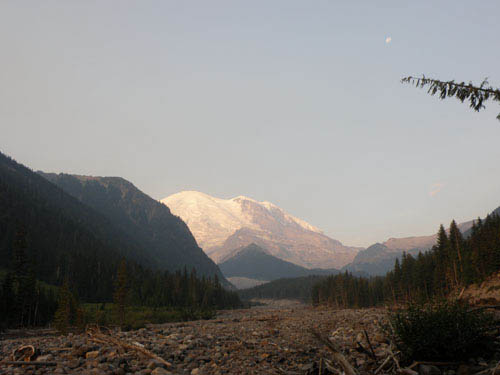
The White River was neither white nor much of a river at this juncture
Think of this 3 mile stretch through the trees that skirts both the aforementioned Fryingpan Creek and the road to the White River Campground as a refreshing, light warm up – peaceful, gentle, plenty of good spots for 20, and just what the doctor ordered before Section 2. Section 2 is F.U. Look for the trailhead parking lot off in the distance to your left at about the 3 mile point, and kiss your leisurely stroll goodbye.
Section 2: Fryingpan Creek to Summerland
Next, it’s time to rise up to the challenge of your rival. This section, like the stairs, go up. Way up. You’ll gain about 2000 feet over the next 5 miles and as the dude from Survivor just reminded me, sometimes it’s OK to be the +1 mile behind straggler especially when Franken has been, shall we say, a little gassy.
This section kicked McLovin’s butt, but damn it was beautiful. The trail itself is comprised mostly of long switchbacks with occasional views of Fryingpan Creek waterfalls, glimpses of the mountain, and eventually some scattered alpine meadows. Get some water from one of the small creeks in this stretch as it’s in short supply in the high country. Keep an eye out for black bear scat 🙂 Your reward for this strenuous climb is Summerland, just short of the famous Panhandle Gap. Oh wait, Panhandle’s still a grim, rocky, snowfield-rich 2+ miles away.
Summerland camp includes a small shelter and a huge meadow that remained colorful and green in September. It’s a popular destination so if your itinerary calls for stops either here or further on at Indian Bar, be sure to get your itinerary in early. [Note: it’s worthwhile to double check your fax submission as we had some difficulty with our first itinerary not being processed – make a call if you haven’t received your confirmation by mail w/in a week].
Section 3: Summerland to Indian Bar
This was estimated to be an 18 mile day, meaning that the halfway point was just ahead near Panhandle Gap, at 6800′ the highest point on the Wonderland Trail. Getting there was rough. The trail here is exposed, very rocky and scattered with snow fields that make wayfinding difficult, especially if you’re not exactly Magellan (like McGelin). Eventually even I reached the panoramic summit, and it was spectacular.
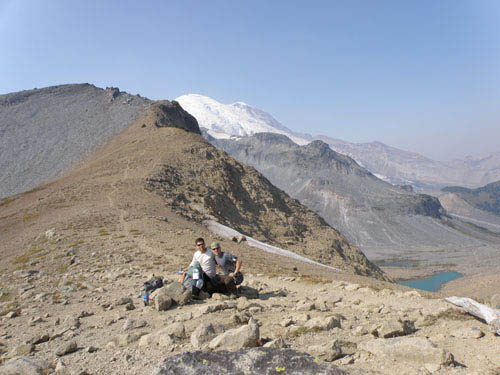
Franken and Ploss beat me by 12 lengths despite enjoying Day 6 on the WLT
The first part of this section was a serious loosener for me, and Franken was kind enough to stay with me while I dealt with quadriceps issues later determined to be the result of constriction from my spandex knee braces. Additionally, I bit it pretty hard as we all negotiated our way around a dangerous snow field covering a glacier-fed stream, and for a scary moment I feared I had twisted an ankle here, equally 9+ miles distant from anything close to “civilization” at the WLT summit. In short, be careful. Thanks again for staying with me Frank! Every-man-for-himself is a risky strategy up here.
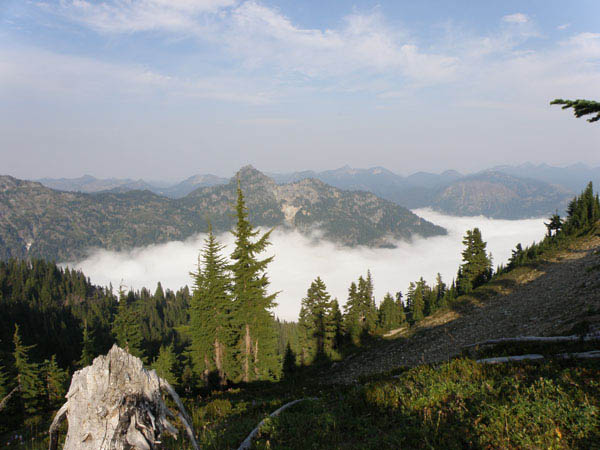
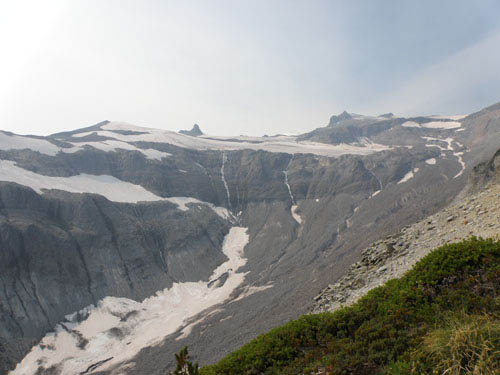
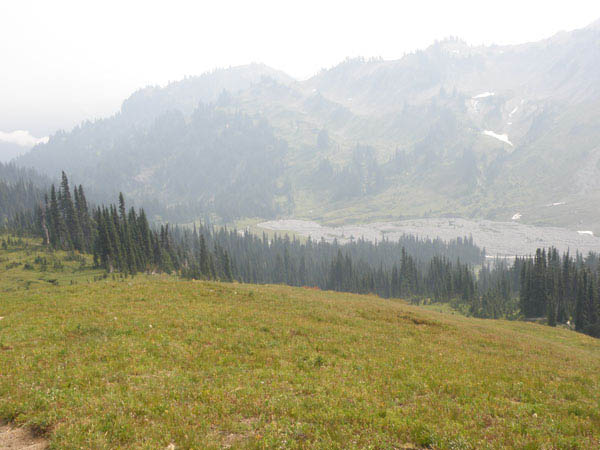
Just beyond Panhandle Gap the terrain starts to descend back close to the treeline as you hike along the knife edge of the summit line. To your left are deep green valleys, where Franken and I thought we may have spotted mountain goats on a distant hillside meadow, and to your right is what amounts to an enormous, stark grey, violently carved natural quarry that continues to rumble while fed by glacial melt extending for several miles with Mt. Rainier in the background.
On the left hand side
It reminded me of the summit point on Mt. St. Helens’ Goat Mountain trail, where the blast zone and pristine forests meet. Franken discovered what would have been a challenging par 7 golf hole complete with a water hazard in the left hand valley that we would have photographed if only our photographer wasn’t like 2 miles ahead. [Note to self: next time bring your own camera and implements/other items].
Mr. Slate would have enjoyed this enormous glacier-carved "quarry"
As we started our descent towards Indian Bar Franken and I saw a wolf running in a meadow perhaps a thousand feet below us on the left hand side, while elk bugled and marmots whistled distantly on all sides. This section concludes with a 2 mile descent back below the timberline through a dense forest, terminating when you hear the sound of water again as you emerge to discover the wide expanse of rocks, water and meadows that is the dramatic Indian Bar.
Descending south towards Indian Bar
Indian Bar was killer. Prior to my arrival Ploss and Franken had a relatively close and otherwise uneventful encounter with a good sized black bear (though brown in color) that was by Ploss’ account his highlight of the whole WLT. I reached the shelter already a man: beat from the journey, but was resolute knowing that the remaining 6.5 miles to Nickel Creek was “downhill.” More on that later. Get some water here, be sure to check out the waterfall by the trail to the lower Indian Bar camps, and do some stretching b/c the “downhill” starts uphill. More uphill than you think. Or want 🙂
Section 4: Indian Bar to Nickel Creek
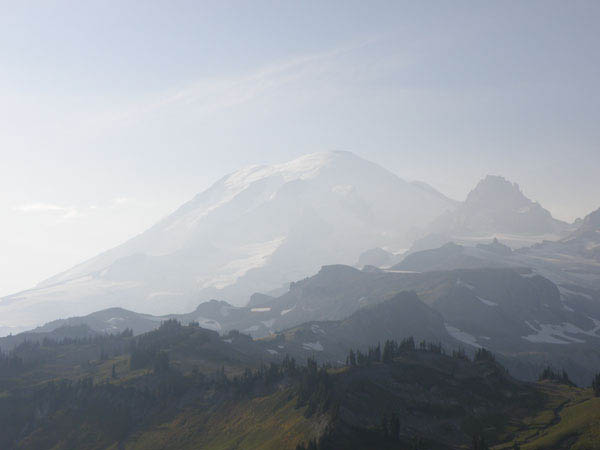
Yep, there’s a good 900 feet of elevation to go before you level off, and behind you are unbelievable views of Mt. Rainier and the Indian Bar valley. It’s also a great place for a shad, but you’ll need to pack a UL spent uranium-tipped pick axe in order to LNT, which I did, as far as you know. Take some time to look back on your way up; you’ll be back right about the timberline before you drop into a series of rolling, up and down alpine meadows that are real head scratchers as you try and figure out when, exactly, you’ll descend to Nickel Creek.
The view north high above and to the south of Indian Bar
Eventually, after a few miles you’ll start to drop into the forest – really drop. On this stretch we separately encountered our first people in some time, some Euro whom I was pretty sure was Linux creator Linus Torvalds and his incommunicado spouse / companion / sherpa. In my conversation with him my spirits dropped: his sweaty exhausted estimate was that Nickel Creek was still 5+ miles away. D’oh! To say this section is steep is an understatement – this gave Ruckel Creek a run for its money, and my knees were hating it. He was also very concerned about the mosquitos at Indian Bar – I gave him the 411 on skeeters (none) but failed to mention the bear. Oops.
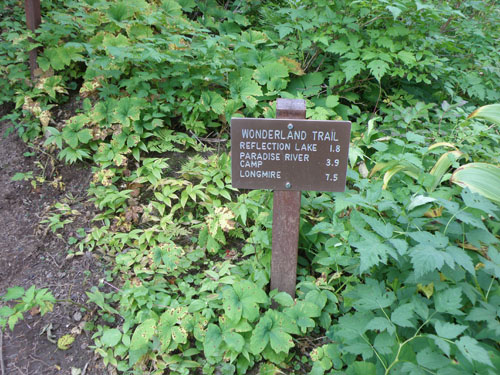
At this point my watch suggested we’d already come nearly 16 miles, and it was getting close to dusk. Time to step on it. This is where the descent becomes truly knee crushing, and just when you think you’re about to reach camp you’ll hit a few switchbacks and a demoralizing sign that reads “NICKEL CREEK CAMP .9 MI.” I double timed it to the spur leading off to Nickel Creek camp where I finally found Ploss and Franken on their way to get water – the camp is about .25 miles above Nickel Creek itself.
At this point, now just after 7pm, the sun had set and the accelerometer indicated that we’d come nearly 22 miles. Nickel Creek camp has a great group spot where we made camp, ate in the dark and slept under the giant “widowmaker” trees that surround this smallish campsite – the end of a grueling and immeasurably satisfying day on the Wonderland Trail.




 smackpacker.com